How to Build a House of Trust
by Arthur Saint-Remy & Clarisse Verbeek
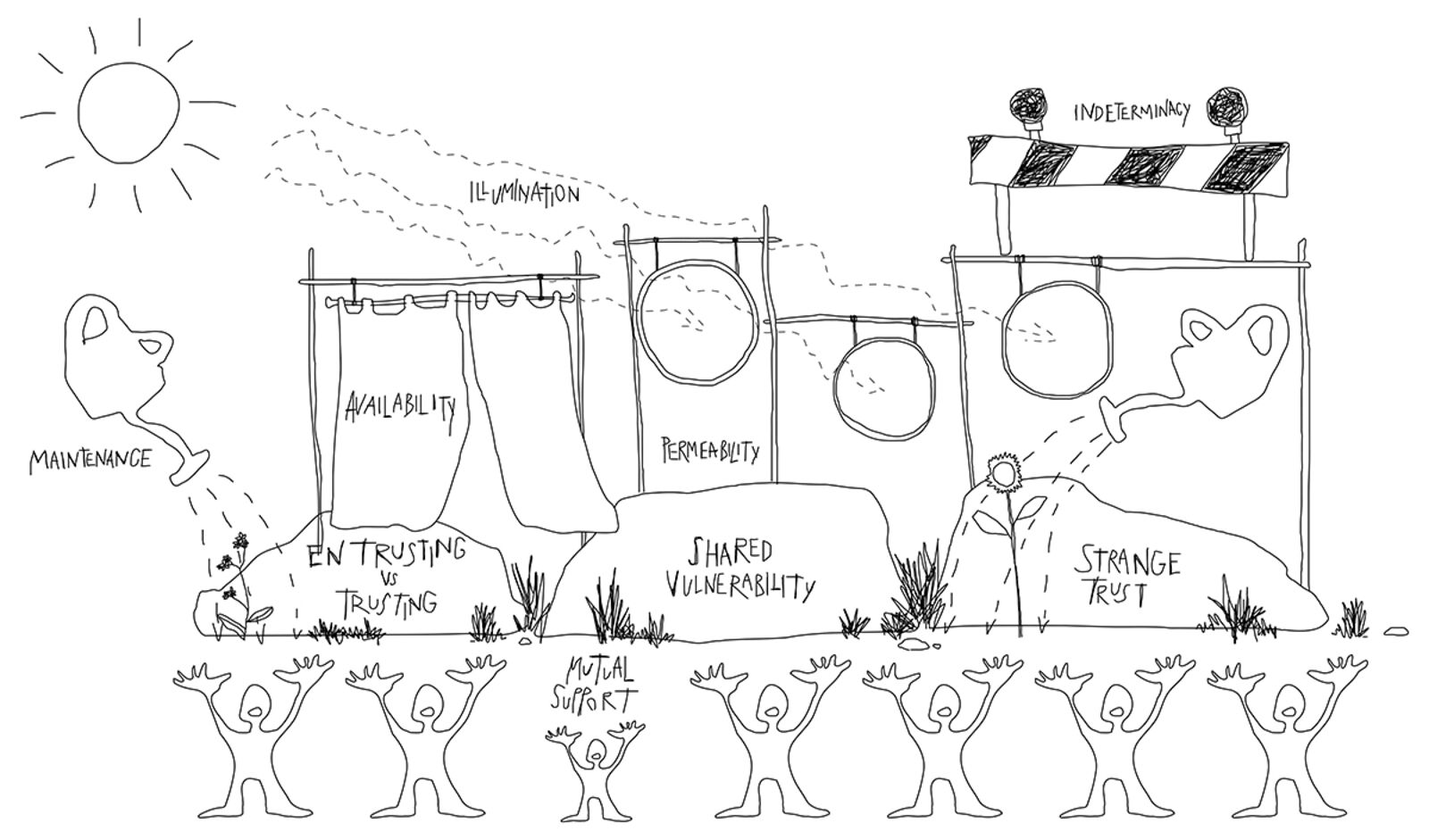
Illustration by Arthur Saint-Remy & Clarisse Verbeek around Pascal Gielen's book, Trust: Building on the Cultural Commons
I’m writing this from de Appel’s foyer, for once not worried about the train I usually have to catch back to Antwerp, since I’m now living in Amsterdam for a couple of weeks. I started my internship at de Appel, supporting Lara Khaldi, in early June. Two weeks ago, Arthur, my partner and a practicing artist, and I visited the freshly opened exhibition Building a House Without Bricks, after having sadly missed the opening—something we do often together, followed by the inevitable debrief. The exhibition is a collaborative effort between the Sandberg Instituut's Lumbung Practice master's, de Appel's Curatorial Programme and Gudskul Collective Studies (Jakarta). Reflecting on the exhibition’s focus on collective organisation of care and resources, we were reminded of my former professor Pascal Gielen's book, Trust: Building on the Cultural Commons, as we both recognised these practices as vital forms of commoning. While revisiting the book, we stumbled upon a question Gielen presents near the closing pages: “How to build a house of trust?”. Some answers can be found in the observations Gielen makes throughout the book. But as the question feels somewhat open in nature, and because of the coincidentally similar phrasing to the exhibition’s title, we agreed that elaborating on this question would be a great exercise in parallel to the exhibition.
We could argue that trust is a pivotal necessity for commoning and for Lumbung practice. Gielen himself quotes from the Dutch Wikipedia page of ‘Vertrouwen’ at the beginning of his book: “If certainty exists, then trust would be unnecessary.” But, in order to start thinking about the practicalities of how to build a house of trust, Gielen presents us with another preliminary question: “What are the aesthetics of trust?” Because, Gielen reminds us, trust is a human feeling, and therefore he expounds the importance of the concept of aesthesis—that which we perceive with our senses—as a necessary corrective to the cold contractual approach to trust which might be characteristic of today’s age and economy. In other words, trust is first and foremost sensible before it is conceivable. It is out of this exclamation—this appeal to aesthesis—that Gielen chisels three cornerstones on which we can start building our house of trust:
○ (Trusting vs Entrusting) Let’s expand our idea of trust with the word entrusting. Trustworthiness is not someone's passive quality, but an active deed of giving space and responsibility because you trust. But trusting implies evaluation and hierarchy: I am putting my trust in you to the test, and therefore you are the one who must prove yourself. Whereas entrusting implies reciprocity: by offering trust, I share the risk with you, rather than placing the burden of proof solely on you.
○ (Shared vulnerability) Trust starts where certainty ends, and sprouts from the recognition of vulnerability and shared dependence. The aesthetic of vulnerability is found in the absence of defence mechanisms.
○ (Strange trust) Breaking tribalism and fear requires trust in the other, in those outside our circle. Let’s be open towards the other before they are ‘one of us’.
These are the three fundamental stones we recognised in Gielen’s book, essential for the building of trust in the broader socio-political project of cultivating the commons. But let’s build on this foundation and bring more building blocks to continue the construction of our house of trust. What other aesthetic qualities give shape to these spaces or structures where trust is built?
○ (Availability) A house of trust is always open like a common, both literally, in physical space, and temporally, in time. Its availability must be determined by needs, and of course, office hours don’t apply. Time is a resource of care that can create safety that allows deeper levels of trust.
○ (Permeability) A house of trust has boundaries like a common. But the structures that outline these boundaries should be permeable – they draw out the contours of areas and transition zones that invite people to drop in and out freely. Just like a relation of trust is built from the possibility to drop in and out at any moment.
○ (Maintenance) Trust requires active engagement to prevent it from fading. It requires attention, maintenance and the resolving of conflict, just like a common and the architecture of a house of trust.
○ (Mutual Support) Neither commons nor trust float on altruism, but on a web of mutual support and reciprocity: we help each other, because we trust that the community will carry us whenever we are in need of help. Trust grows when we start noticing the indirect return on investment in the form of a support structure.
○ (Illumination) Like Gielen highlights, transparency in governmental terms—audits, control mechanisms, public accountability—is not a sufficient condition for the building of trust and the commons. But decisions made in the shadows of backrooms breeds distrust. Let’s allow light into processes so actions can be seen and understood, acting together ‘on stage’.
○ (Indeterminacy) This concludes our exercise so far. But the common is not a structure that is ever final or finished, like a nation state that has its clear boundaries, which is why we speak of the verb and process of commoning: the ongoing practice of becoming. For this reason, and because we want our house of trust to remain alive, we want to leave space and invite you to add your own stones!
What aesthetic qualities are missing in your context? The result is a growing collection, laid out on a Canva board, which we invite you to explore and to build on further.