Different Characters, Shared Values
A Conversation about Cooperative Living with Andrea Verdecchia
by Eli Witteman
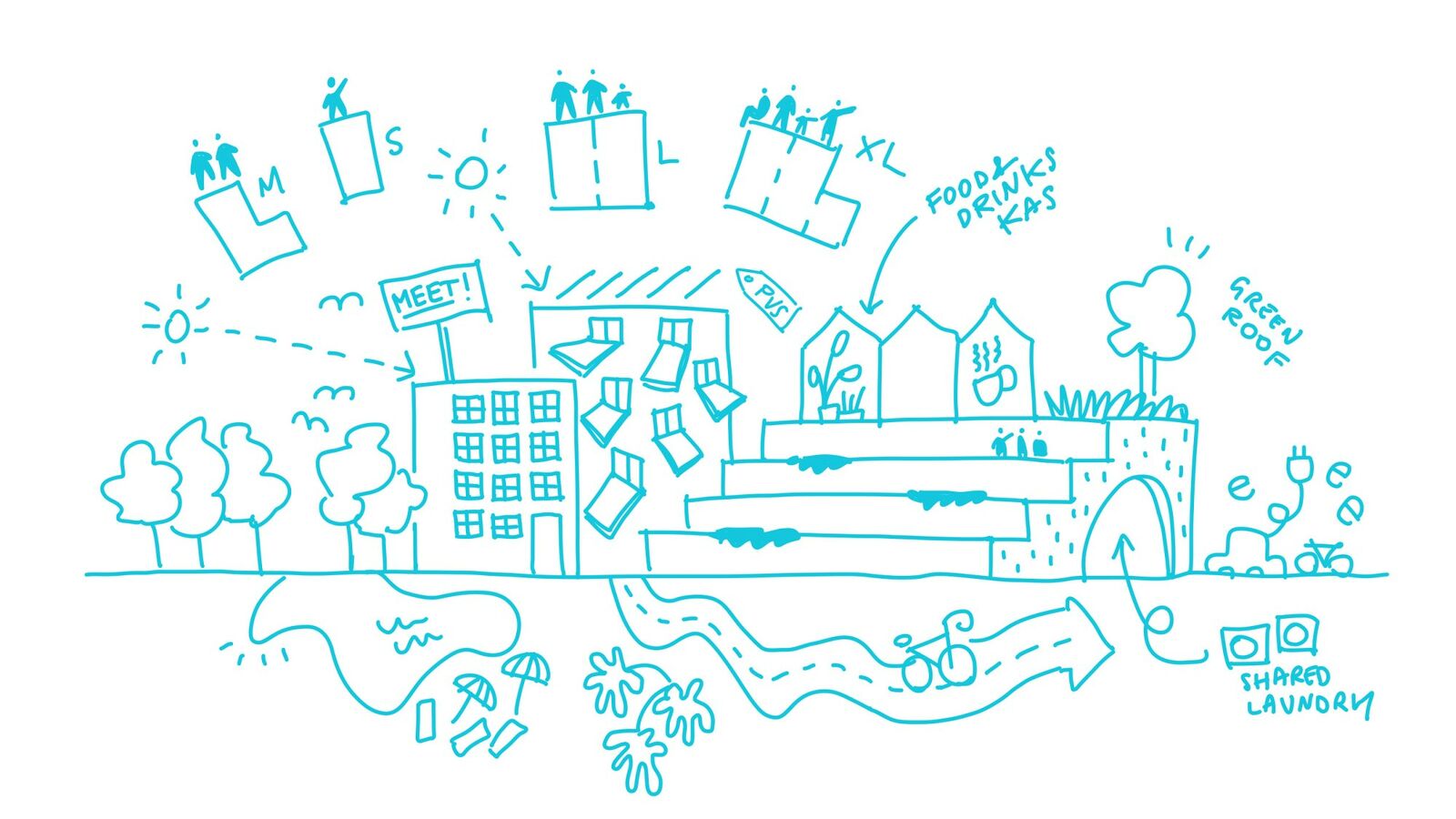
Affordable Housing, drawing courtesy of Time to Acces architects
When I ask people what their ideal way of living is, the answer often goes along the lines of ‘collectively’. A type of living in which duties, decision-making processes, and part of daily life is shared among the whole group that lives together. It’s a romantic and ideological way of thinking, but how many people can make this happen? And in what way would they do that? In search of answers to these questions, I came across de Nieuwe Meent, a new housing cooperative in Amsterdam East, which officially opened its doors and became inhabited in the summer of 2025. It is one of the small (but growing) number of housing cooperatives in Amsterdam. The building is designed by architecture bureau Time to Access in collaboration with Office Raumplan. On a sunny Friday morning in June 2026, I met with Andrea Verdecchia of Time to Access, at their office in de Nieuwe Meent, for a conversation and a tour around the building.
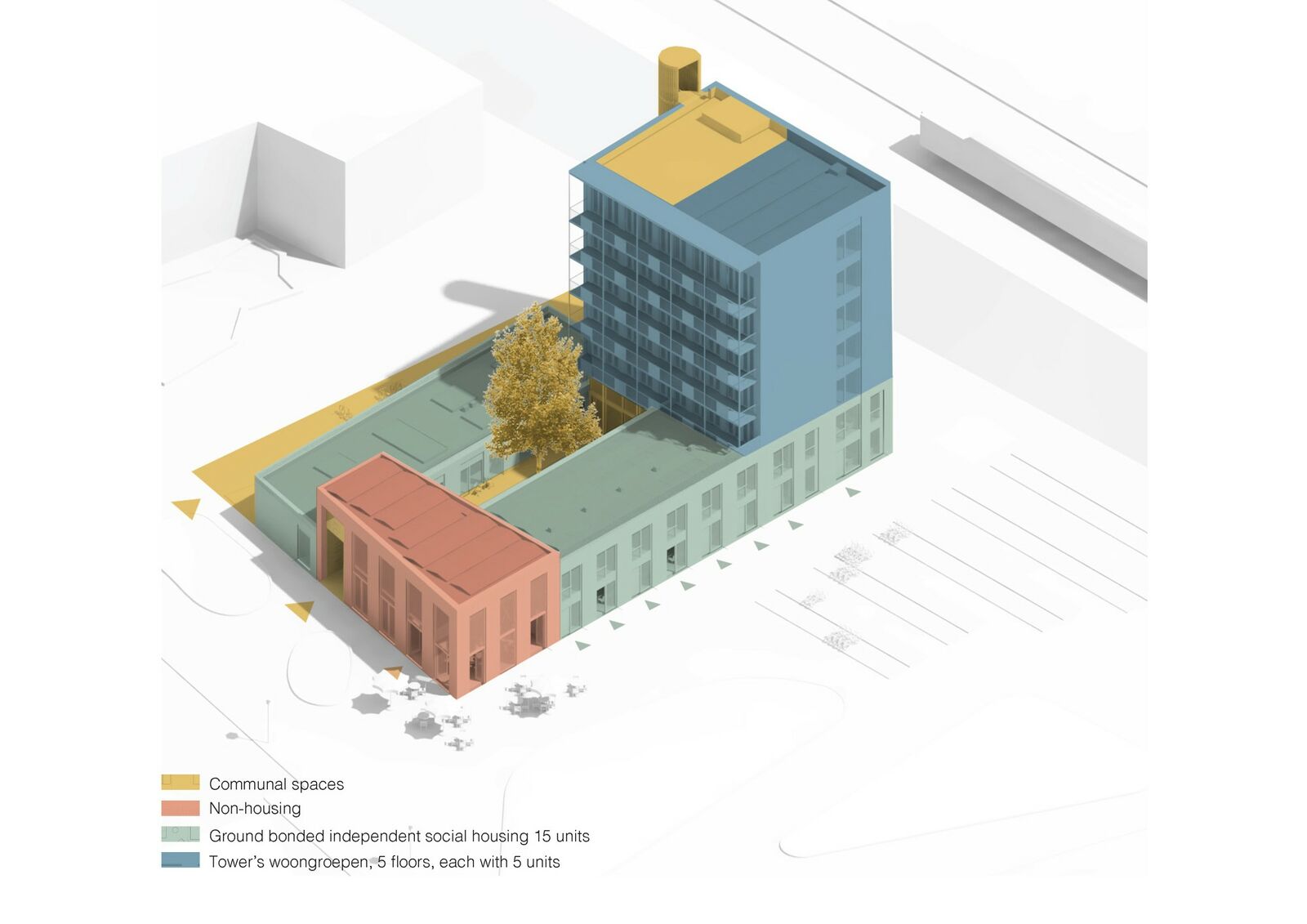
Housingcoöperation de Nieuwe Meent, a housing cooperative organised around the principles of commoning, 2018-2025, courtesy of Time to Access architects and co-founders
Andrea and his colleague Mira Nekova were already involved at the beginning of the project. The idea to start de Nieuwe Meent, a housing cooperative built on the idea of the commons, came from a volunteer group gathering at socio-political centre NieuwLand. Most of the people in this group knew each other through environmental activism. They were looking for someone with a technical background to get involved with the new housing cooperative and help the project take shape. Andrea and Mira joined the cooperative as volunteers and afterwards started Time to Access together.
After we shake hands to introduce ourselves, we start our tour through de Nieuwe Meent. The building doesn’t only have apartments and offices, it also houses a cafe (noon coffee & culture) in the plinth. The coffee shop is filled with bookshelves, mostly with books from Shaam (current-day Syria, Lebanon, Palestine and Jordan). Andrea and I get two cups of coffee and one slice of banana bread, and we move into one of the building’s communal spaces to have our conversation. The cafe is not just for the residents but is also meant as a place for the neighbourhood, where people meet each other and connect, which is one of the core desires of the members of de Nieuwe Meent.
Andrea tells me that Time to Access works in an uncommon way: as architects and as co-developers. They prefer to be part of the project from the beginning, connecting with those involved with the projects, gathering input through working groups. They use the design as a vehicle to help develop the future organisation of the housing cooperatives. Designing a housing cooperative is a process that never ends, even after the building has finished. You need to keep addressing what the values of the cooperative are, and how you choose to live together.
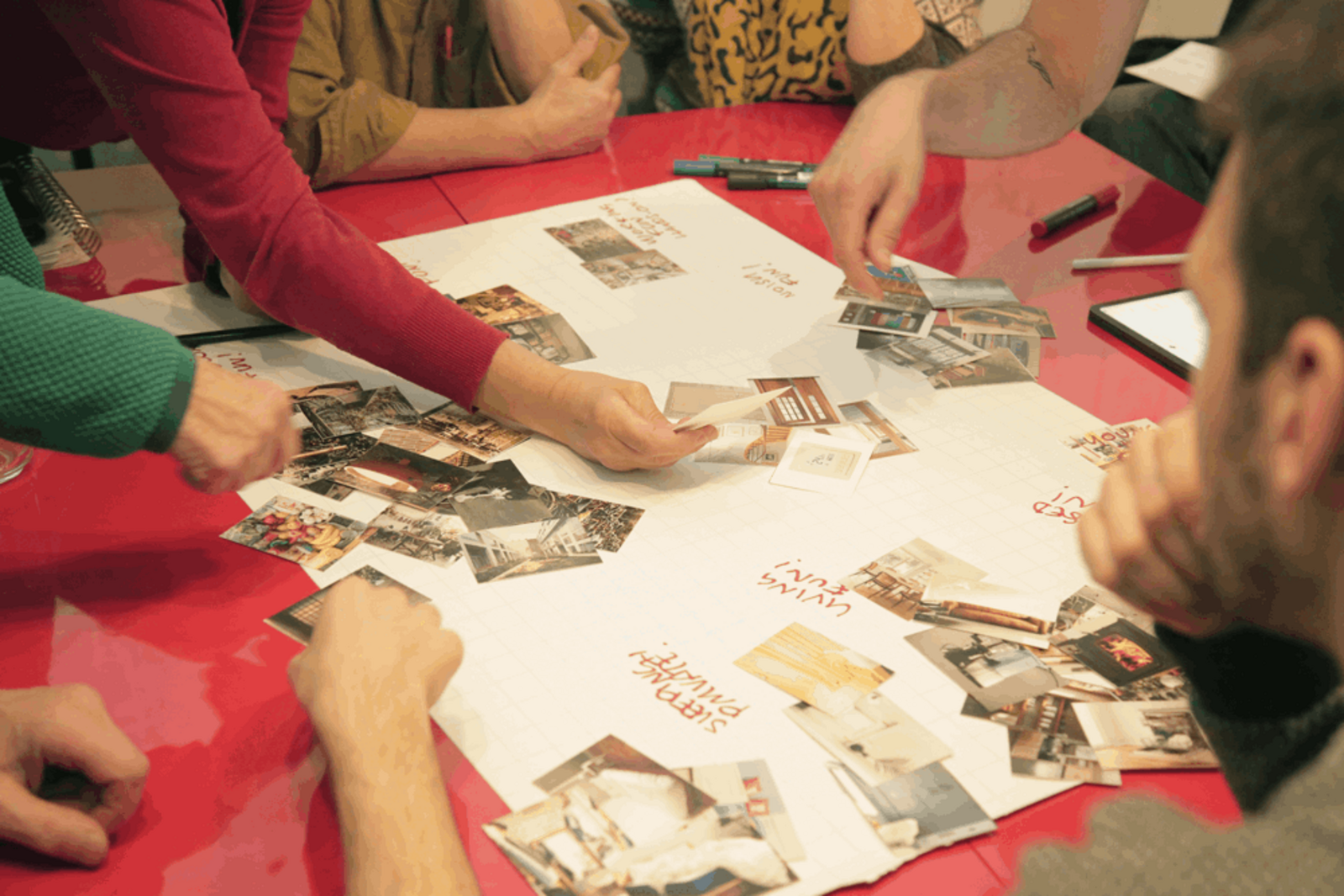
Cards game, courtesy of Time to Access architects
Since the building process of de Nieuwe Meent has now been completed, Andrea and Mira are working on other housing cooperatives, such as De Bundel, in Amsterdam Nieuw-West. This group was started by people living in the neighbourhood, who would meet regularly in the community centre Ru Paré (also in Nieuw-West). They came together to resist gentrification. By starting a housing cooperative, they try to make sure that inhabitants of the neighbourhood can stay in the neighbourhood. De Bundel will consist of 130 apartments, at least 60% of which will be for people currently living in the neighbourhood. But there are even more housing cooperatives that Time to Access is designing: one to house nurses and other employees of the OLVG hospital (Woonvereniging De Walvis), one in Utrecht (Wooncoöperatie Hommeldorp), and one in the Bijlmer (House of Hope).
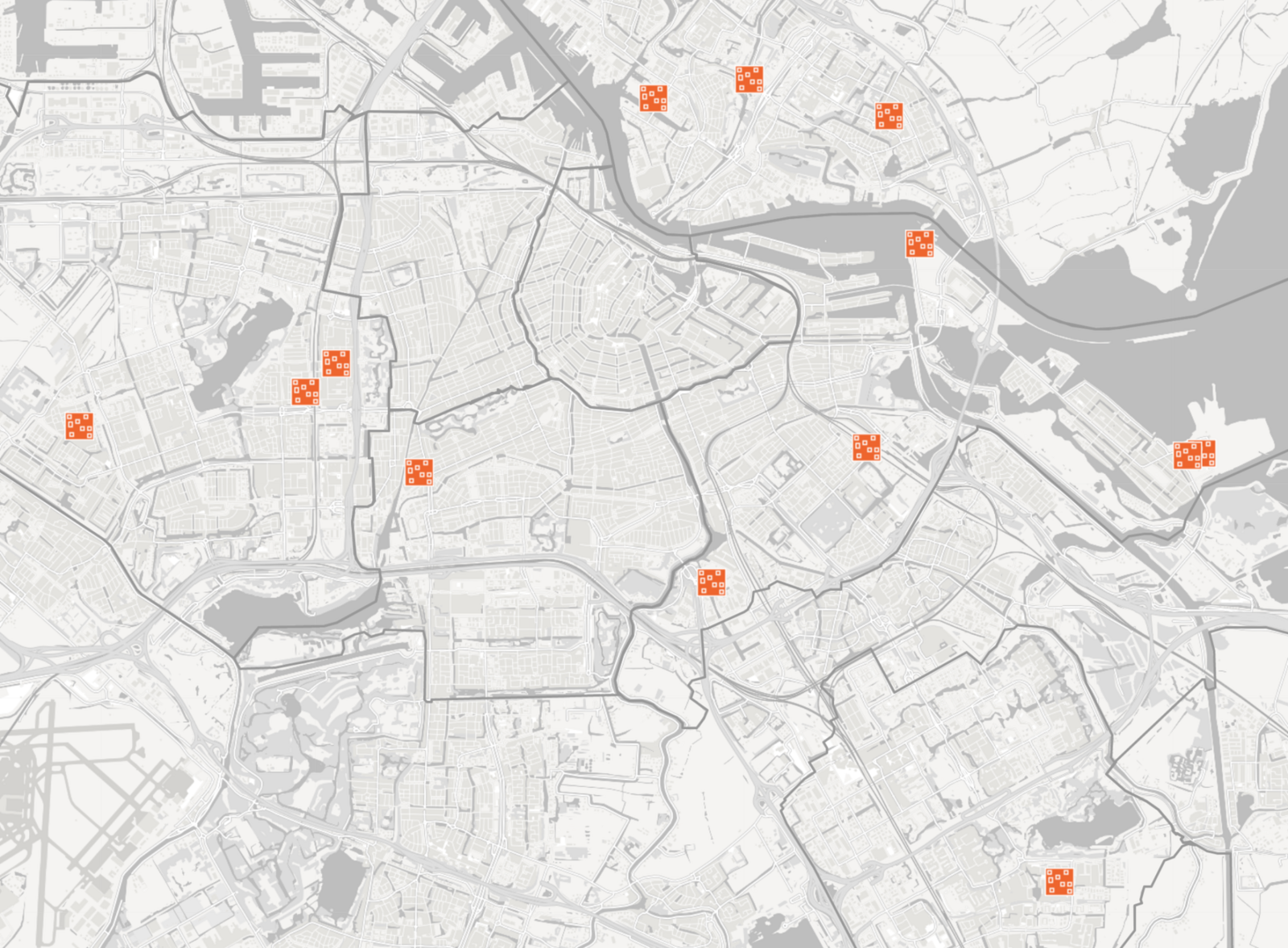
Map of housing cooperatives, July 2022, Time to Access architects
Every one of these cooperatives has its own character. At de Nieuwe Meent, housing as commons was what stood central, which entails monthly general meetings, and everyone being part of a council or a working group. For the nurses, that is totally different: for them, it is impossible to meet with all the members, as they all work at different hours, often with night shifts. Their project is run and maintained by a smaller group of people. This shows that not every housing cooperative has the same ideals. Even though housing cooperatives and the commons are usually associated with the political left, there is also an example of a far-right group in Italy with their own housing cooperative. The thought is: ‘If the state doesn’t do it, we do it ourselves!’ A sentiment alive in left-wing, right-wing and in apolitical movements.
Because of the experience with self-developed projects such as NieuwLand and de Nieuwe Meent, Time to Access can organise themselves in a different way than the average architecture bureau. There is no ‘I’m the expert’ – the space for input is open to everyone and anyone. Architecture, in this sense, aims not only to design and develop the building, but also to discuss and lay out its very groundwork. They start with designing the process, rather than the building: Who is making decisions? When are they doing that? And what do they decide on? And later: How big should the apartments be? How many should there be? What is the division between the collective spaces and the private spaces? Most of the spaces in de Nieuwe Meent are shared, while only small parts of the building are private: to live sustainably is to live compactly, with big communal spaces. Apart from the private apartments, there are five living groups, all with a different demographic. There is a living group for people aged over 55, there is a group for queer people, there is even a group that is a non-nuclear family. Decisions are made on consensus, which means it takes a lot of work and time to get everyone on board. The biggest difficulty they run into is the workload, which can be overwhelming.
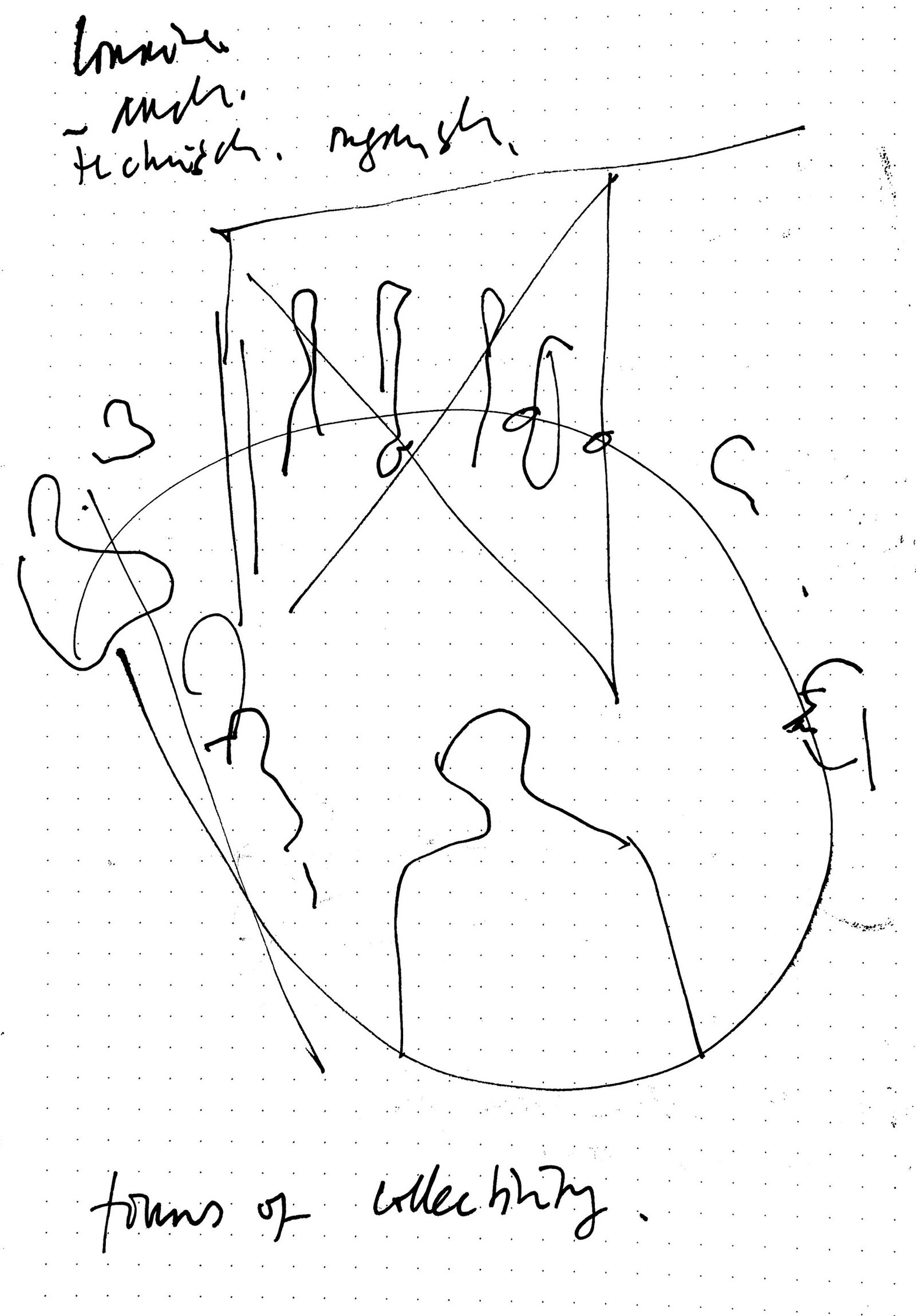
Forms of Collecitvity, sketch by Lada Hršak for 'De Glazen Bundel, a co-created greenhouse on the site of De Bundel
Andrea shows me around, and we take the elevator up to the fifth floor, to enter the house of queer living group ‘The Gayas’. In the elevator, there are activist stickers attached to the wall with magnets. We take off our shoes, walk through the door and are received by one of the residents. The apartment has five bedrooms, all connected through the balcony on the south side, from which a Palestinian flag hangs. The enormous living room has a dining table long enough to host ten people (if not more).
I ask Andrea what his ideal city would look like. Is that a city in which everyone lives in a housing cooperative? He replies that that is not necessarily the case, but that in his ideal city, at least there would be more cooperatives. When you look internationally, the Netherlands is very far behind in developing housing cooperatives. The reason? The Dutch housing system developed around housing corporations, leaving relatively little space for independent cooperative housing. The revised Woningwet (Housing Act) of 2015 gave housing cooperatives an explicit place in Dutch housing law. Slowly, ambassadors for housing cooperatives are making their case within (national) politics, which makes things a bit easier. But it’s still quite difficult to build a real foundation for housing cooperatives in the Netherlands.
Another bug in the Dutch system is that housing cooperatives are not allowed to set up a second housing cooperative. This means that the knowledge and the experience of developing such a project stays within the project, whereas it would be helpful if housing cooperatives could (co-)develop a second housing cooperative and create even more possibilities for people who want to live collectively. You’re allowed to share your knowledge, but you’re not allowed to build more with it.
As we go out of the building and bring our cups back to the cafe, I look around and I see an ideology come to life. As I bike away, the Sudanese flag, the Palestinian flag and the pride flag on the balconies of the different living groups wave me goodbye. De Nieuwe Meent didn’t only give an answer to the question of what the ideal city would look like, they made it into an immersive 3D experience.
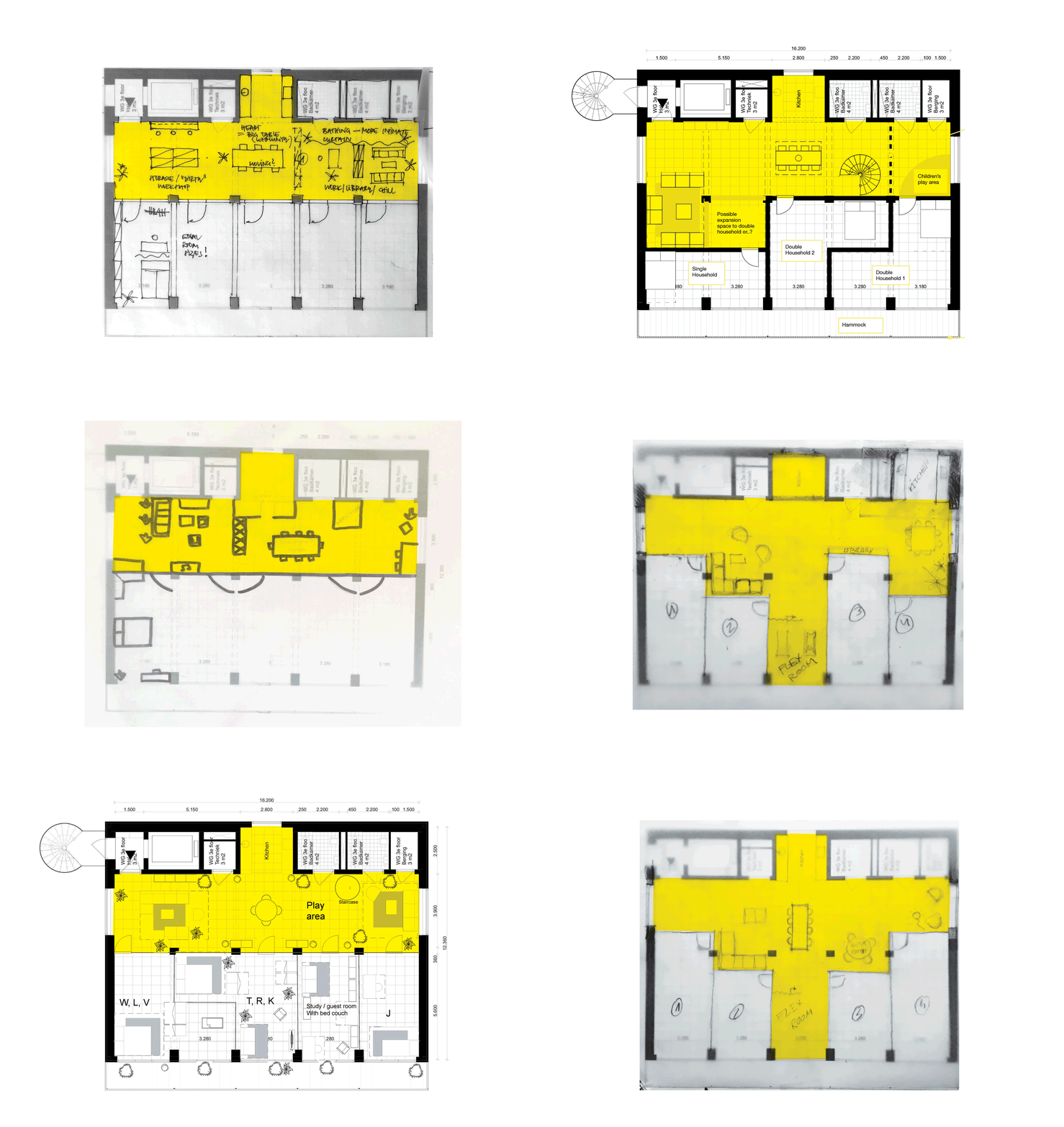
GIF of sketches for communal space within de Nieuwe Meent, Amsterdam, courtesy of Time to Access architects