Kiosks of Value: Rethinking money at the market in Amsterdam door Thomas Siderius
An economics essay on de Appel Kiosk, an ongoing project in which de Appel’s participates in street markets in Amsterdam. It functions as a platform where artists and collectives develop and sell merchandise to explore and experiment with alternative economies. The series of Kiosk projects in 2025 was comprised of: Buurtijs by Honey Jones-Hughes & Antonio de la Hera, Social B̶a̶n̶k̶ by Saemundur Thor Helgason and de aardAppel by Özgür Atlagan & Ulufer Çelik. The piece that follows, written by researcher Thomas Siderius, contemplates the value assigned to money and its function in a neoliberal context, while reflecting on the proposals for alternative economies within the Kiosk projects.
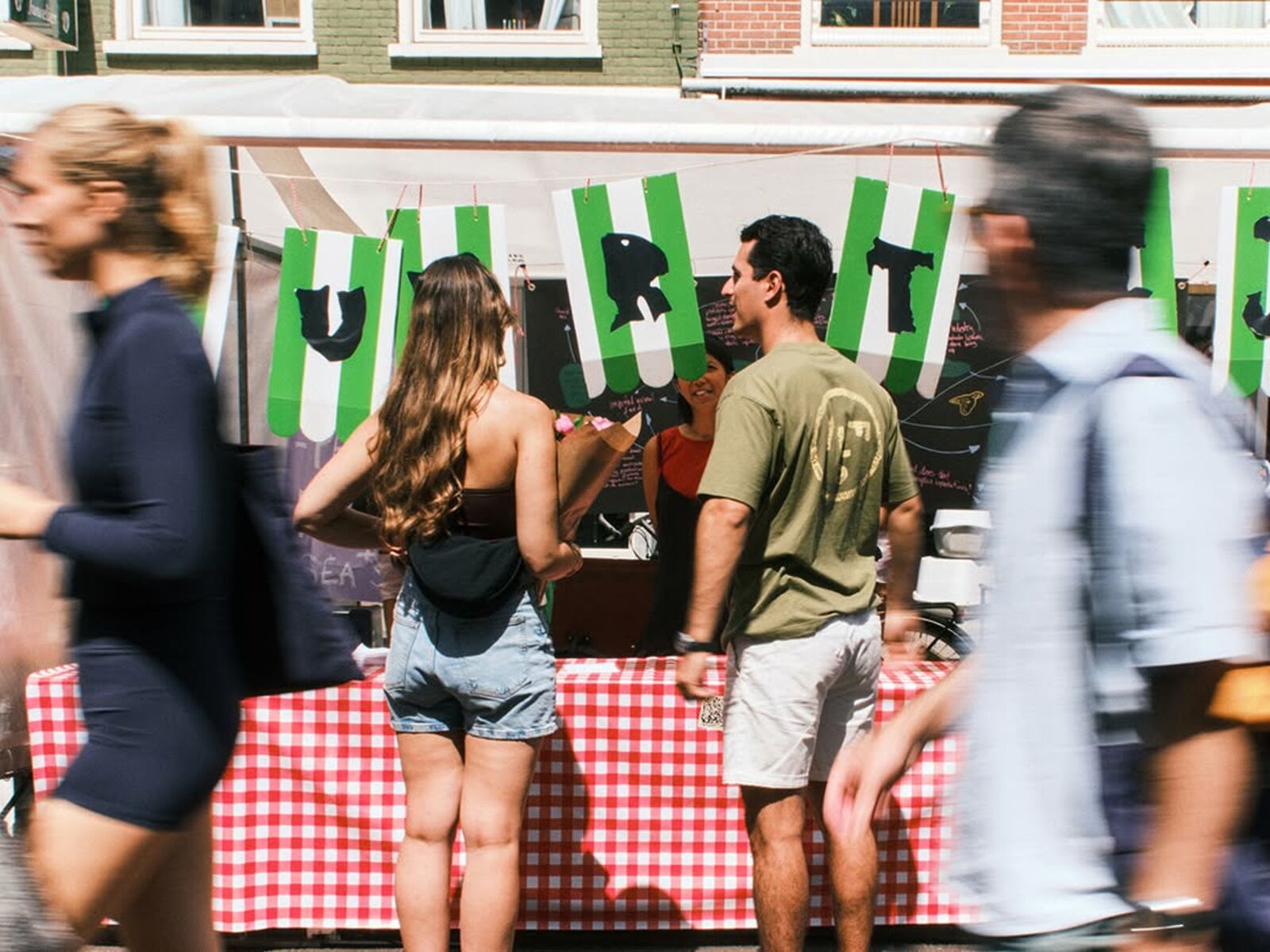
Buurtijs by Honey Jones-Hughes & Antonio de la Hera, de Appel Kiosk. Photo: Nikola Lamburov
On the 17th of May 2025, Amsterdam Alternative, in collaboration with de Appel, organised an event focused on community currencies. In the summer, de Appel’s ‘Kiosks’ returned to Dappermarkt and Albert Cuypmarkt, showcasing three different projects that challenge our thinking and practices around exchange, reciprocity, markets and money. This piece reflects on those projects and asks broader questions about the political, social and cultural meaning of money.
1. What’s wrong with money?
Money is the root of all evil. Or at least, so I’ve heard. A conventional wisdom that has echoed through cultures since biblical times. We know this proverb has been with us for such a long time, as it is actually a misquotation of a biblical passage from Timothy (6:10): “For the love of money is the root of all kinds of evil. And some people, craving money, have wandered from the true faith and pierced themselves with many sorrows.” A subtle but significant difference can be spotted, as the subject of the ‘evil’ in the original biblical text is not money itself, but rather the love of money: greed, obsession, or the relentless pursuit of money at any cost.
Now, many readers, I presume, would tend to agree more with the biblical version of the saying than its modern iteration. Money, after all, is a neutral means of exchange — it’s the human flaws of greed, indifference and selfishness that are the real culprit here. It’s the so-called survival of the fittest logic of our evolutionary biology that drives us toward these behaviours, as Darwin taught us; this greed is just an escalated form of basic self-preservation. Then Adam Smith came along and explained how, if everyone acts in a way that maximises their own self-interest, the market’s invisible hand will balance things out. Therefore, it’s just those who get lost in this excessive pursuit of money that are to be blamed. Or so I’ve heard.
No. Studying the nature of money and the consequences of its design has led me to rather strongly disagree with this worldview. In fact, among scholars of monetary design (whether Silvio Gesell, Bernard Lietaer, Thomas Greco, Ester Barinaga and many others), there is widespread agreement that money is not neutral at all. The view described above is not only a blatant bastardisation or misreading of both Darwin and Smith, but also a view very convenient to those on top of the socio-economic pyramid. It draws our attention away from the actual structures and governance of the infrastructures we use, diverting it towards individual moral failing and implicitly endorsing the injustices perpetuated by a fundamentally flawed system.
Money is not some force of nature. It’s an engineered system with rules determined, created and controlled by humans and the institutions we’ve built. Most money in circulation today has been created by commercial banks (no, not by governments or central banks!) through debt with interest. This means that, as a society or community, in order to pay off a debt that is, crucially, larger than the actual amount of money created, money must be constantly extracted from circulation, leading to an ever-present shortage of it in the real economy. This drives competition and a persistent pressure to grow, accelerating the commoditisation of our natural resources. At the same time, the application of interest transforms money from a means into an end in itself, since by having money, you make more of it. And if you don’t have it, you pay the interest. Large companies get easy access to cheap capital and loans, but small ones pay top rates.
This architecture, these rules, don’t just shape markets, they shape behaviour. They reward hoarding and punish sharing. Inequality and our relentless pursuit of wealth and growth are not bugs of human nature, they’re features and outcomes of the structures we inhabit. The problem is not individual greed, but a monetary design that compels us to act as if we were greedy.
The tendency to appeal to human nature as the crucial flaw is perhaps satisfying but misguided. As any close reader of Darwin will acknowledge, a more accurate summary of his evolutionary theory would be survival of the most adaptable, as he emphasised cooperation and symbiosis as much as he did competition. Similarly, Adam Smith did not truly believe humans were just driven to maximise self-interest, or that this is how we ought to organise our economic system. In his less famous but more thoughtful work The Theory of Moral Sentiments, he wrote extensively about the importance of balancing our self-interest with a broader acknowledgment of our interdependence. Yet, over time, these narratives have been weaponised to ‘naturalise’ inequality and shift blame onto individuals. It’s a kind of ideological sleight of hand, diverting attention away from the rules and structures that produce scarcity and exclusion by design, and allowing those who benefit most from these structures to claim the system is simply reflecting human nature.
So, what happens if we step outside of this logic? When money and exchange relations can be reimagined in a local context? At the invitation of de Appel, I visited three experiments that rethink what money could do if it were designed differently. These weren’t abstract theories, but practical interventions. The Social B̶a̶n̶k̶, de aardAppel and Buurtijs offer us glimpses into economies with different rules: not based on accumulation and extraction, but on trust and reciprocity.
2. The Social B̶a̶n̶k̶ by Saemundur Thor Helgason
A seemingly regular summer afternoon at the Dappermarkt in Amsterdam Oost. Diverse stalls of food, clothing and crafts are displaying their wares on a single, long street, while the local people browse and greet the stall-owners with an endearing familiarity. At one of the crossroads in the middle of the market, besides the vegetable stall and across from the fish place, I spot an unconventional market stall. “Interest-Free Loans”, I read in big, bold black letters on a large white sheet, in three languages: Dutch, English and Arabic. Sitting in a chair behind the three sheets on the stall, I meet the Icelandic artist Saemundur, the initiator of The Social B̶a̶n̶k̶, and Safae, a Dutch-Moroccan student from Amsterdam Nieuw-West.
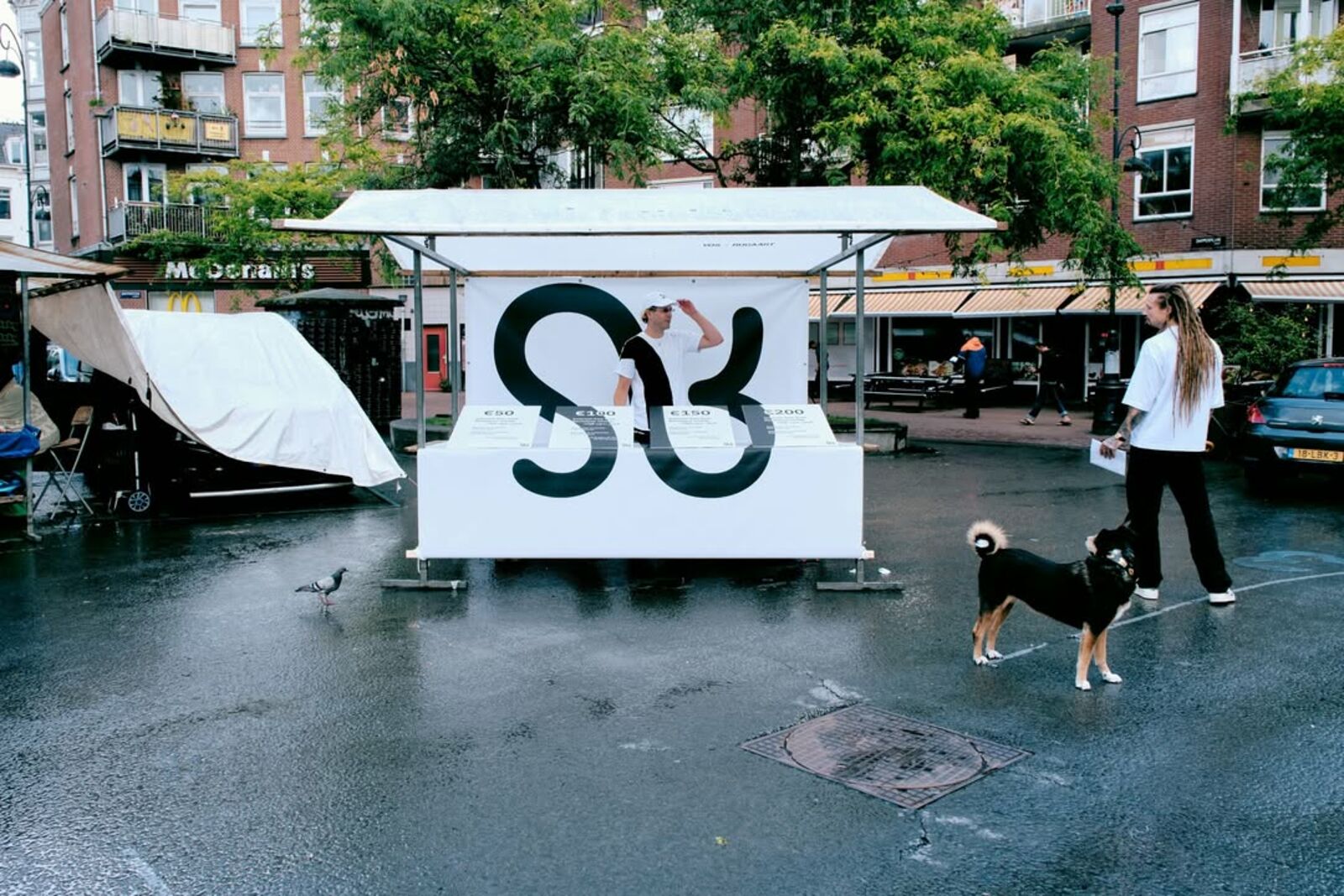
Social B̶a̶n̶k̶ by Saemundur Thor Helgason, de Appel Kiosk. Photo: Nikola Lamburov
Saemundur greets me and hands me a brochure so I can get a sense of the concept of The Social B̶a̶n̶k̶, while he finishes a conversation with a bystander. “The Social B̶a̶n̶k̶ is not a social bank”, is the first thing I read. It just provides a financial service in the shape of interest-free loans, between €50 and €200 for people over 21. Their funding comes from donations from art organisations, companies and individuals, meaning their budget is limited. The repayment period is 3 months and the loans are based entirely on mutual trust: failing to repay has no negative financial consequences whatsoever. If there are insufficient funds in the borrower's account on the agreed date of the repayment, The Social B̶a̶n̶k̶ will get in touch to find a solution. If necessary, the bank will create a new loan agreement for the remainder of the loan. This structure avoids debt collection agencies and does not punish people for their difficulties in making ends meet.
I ask Saemundur how it’s going with this peculiar concept. Where does it come from? How are people reacting? Are many loans given out? I feel tempted to assume that many people will take advantage of this ‘free money’. He explains that he’s been doing art work around the topic of economics for about a decade now, having started an advocacy group for Universal Basic Income in Iceland, as he is concerned about the maldistributions of wealth. This idea actually came from his mother, who has been saying for years that Iceland needs a kind of social bank, since interest rates are usually so high that regular people or small businesses have limited access to money or credit: “the system in Iceland is rigged for the rich.” Of course, this is not just an Icelandic problem, and therefore he has created the SB Foundation (as it’s illegal to call yourself a bank without a banking license). The goal is to rethink the role of banks in our society: what does it mean for us that these for-profit companies can create and control our money supply?
He continues by saying that everyday they’ve been at the market, their maximum loan capacity has been reached. So far they haven’t had any trouble with repayments, since the repayment period is only just starting at the time of our conversation. As he tells his story, a Palestinian man from the neighborhood sits down and signs a contract for a €100 loan. People are interested and take loans for varying reasons, whether to cover an unexpected cost, to take their kids or partner on a nice day out, or make some incidental purchase, Saemundur says. What he learned here is how much this concept resonates with the local Muslim population, as interest (riba) is seen as haram, or unethical and exploitative. A lot of people have asked him whether this is an Islamic initiative, to which he would say both yes and no: “It’s great that Islamic people are excited about the idea, however, this is for the good of all people.”
I talk to Safae about this. She confirms the many enthusiastic reactions from the Islamic community here. Having the explanations available in Arabic surely helped spark their curiosity. Current options for people of Islamic faith to engage with interest-free banking are practically non-existent in Western Europe. As a Muslim growing up in Amsterdam Nieuw-West herself, she knows many individuals and entrepreneurs in her community that would be very interested in gaining access to interest-free loans, albeit maybe at a larger scale.
This reminded me of the Swedish JAK Bank, the Swiss WIR Bank, and the more recent Sardex network in Italy, which were all founded on principles of interest-free banking, and have therefore also seen disproportional adoption from Muslim migrant communities in their respective areas. Saemundur told me about his ambition to acquire a real banking license, so that he can expand his possibilities and eventually make social, interest-free banking available for everyone. Could western cities with sizable Islamic populations be the key to reach the critical mass necessary for the successful upscaling of interest-free banking?
3. de AardAppel by Özgür Atlagan & Ulufer Çelik
A week later I return to Dappermarkt. This time I spot both the Buurtijs & AardAppel initiatives, in the same area that The Social B̶a̶n̶k̶ was located. I first meet Ulufer and Özgür, two artists of Turkish origin, and ask them about their concept. It’s surprisingly simple: they have a big batch of potato salad, prepared with curry-spices, based on an Indian recipe. It looks and smells delicious, so I ask how I can get in on some of that potato-action. I can choose: pay €2, or share a story or recipe related to potatoes.
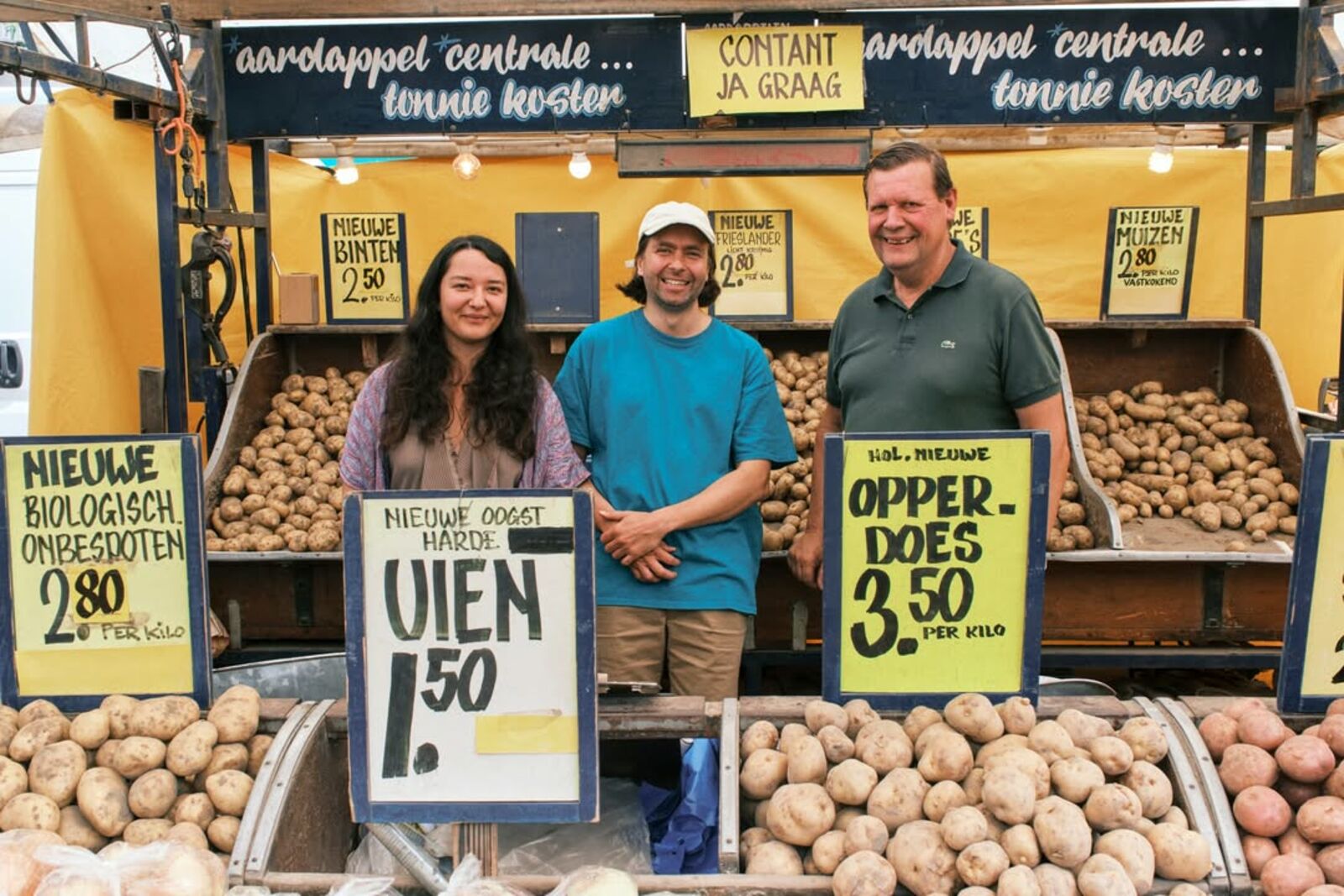
de aardAppel by Özgür Atlagan & Ulufer Çelik, de Appel Kiosk. Photo: Nikola Lamburov
Naturally, I share my potato-story, about how I ate boring plain boiled potatoes for my entire childhood. Admittedly, it’s not the best story I’ve told, but it was worthy enough to receive the potato salad. Whilst I’m munching on the acquired potatoes, Ulufer elaborates. She shows their book filled with a wide and growing diversity of potato recipes. She explains how some people prefer to just pay €2, but most enjoy sharing a story or recipe as a means of exchange. “The way people treat our concept kind of reflects society. Some just want or need some free food, whereas others really enjoy contributing something.” One elderly man stuck around for an hour, going into great detail with stories of the potato riots in Amsterdam during the First World War. Someone else shared an elaborate recipe that had been in their family for generations.
The nature of these exchanges were therefore of a very different order than our usual transactions. At the end of the day, the result was not a full cash register, a healthy balance sheet or a decent return on investment, but rather a series of new encounters and a catalogue of culinary community wisdom. Ulufer admits that this is not what you would call a ‘sustainable business model’, but clearly that wasn’t the point. It’s an exercise in reflecting on value as relational instead of transactional. How different people interact and engage with this concept can tell us a lot about assumptions around what constitutes value or ‘worth’.
I can’t help but think of David Graeber’s work Debt: The First 5,000 Years, on the history of debt and social currencies. Before modern currencies emerged, what could be used as a means of exchange was much more versatile. A sense of obligation and reciprocity was central to exchange far before formal markets existed. This strengthened community ties and instilled trust within and between trading groups.
Now, neither Ulufer, Özgür or myself is advocating to go back to hunter-gatherer societies or start using stories instead of money at the supermarket. Nevertheless, this is a very valuable exercise in discussing and experiencing value exchange outside of monetary boundaries, with close attention to our social and communal nature. In that sense, this project can surely be deemed successful.
4. Buurtijs by Honey Jones-Hughes & Antonio de la Hera
Time for dessert. I talk to Antonio and Honey, co-founders of the Buurtijs project, as they show me the different flavours of ice cream they’ve created. At Buurtijs — which can be characterised as an art project rather than an ice cream business — they strongly believe that local, healthy and sustainable food should be available and affordable to anyone, and they have adopted an innovative pricing system. Their ice cream is made exclusively with local products and facilities, with ingredients sourced from Voedselpark Amsterdam, MoMa Melkboer, Boerderij de Boterbloem, Fruittuin van West and SET Community Gardens. However, before I could dig in, I was asked to fill in a little form to determine what I should pay, since the price wasn’t set in stone but was based on what they called a solidarity payment structure.
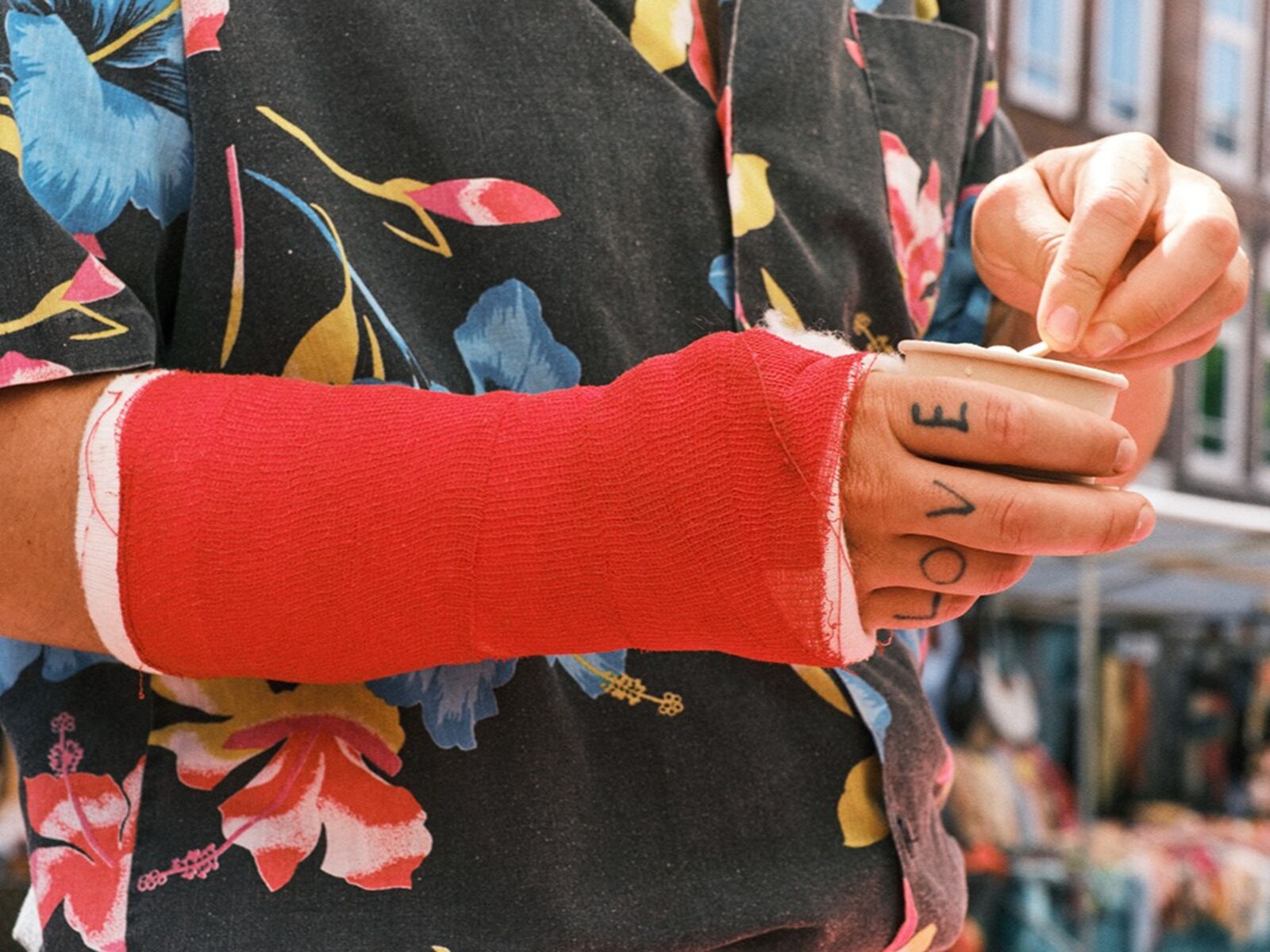
Buurtijs by Honey Jones-Hughes & Antonio de la Hera, de Appel Kiosk. Photo: Nikola Lamburov
The idea, which originated from Elske Hageraats’ farm De Ommuurde Tuin, was to invite people to think of their time as a benchmark of value. They calculated that the production time per ice cream was about 15 minutes. Therefore, the price you would have to pay should be equal to what you earn in 15 minutes. Now, I had to disclose my salary, calculate my hourly wage, and divide it by 4 to arrive at my personal price. As I’m struggling to reverse-engineer my hourly wage as a civil servant, Antonio explains that the point of this type of pricing is not only to match the time and labour going into the production of something, but also to create awareness of local value chains and the costs of producing locally. This structure makes it proportionally equal for everyone and should therefore make it affordable for everyone, across all income levels, to enjoy healthy, local food.
After taking some time to estimate my hourly wage, I paid €7.50 and got my dessert. I picked the pear flavour, which was seriously delicious. Yet, despite my positive convictions about financial transparency, I find it pretty uncomfortable to do this publicly at the market. Also, €7.50 feels expensive for a small cup of ice cream. I guess transparency is uncomfortable when it confronts privilege and convenience.
Antonio acknowledges my discomfort, and says it’s not an uncommon reaction, as most people are not readily very open about their salary. Besides, not many people are willing to pay such a price if, as in my case, it turns out to be much higher than usual. On the other hand, this very dynamic would enable people with a lower income to get access to these healthy local products. In fact, some children and unemployed locals were able to receive the ice cream for a grand total of €0. This is community solidarity in action: the core of the Buurtijs project.
Another common reaction, Antonio says, is that buying local is now being conflated with buying luxury. It appears to have become a privilege, almost a yuppie thing to do. Generally, if you struggle to make ends meet financially, you’ll shop at the cheaper supermarket and rarely, if ever, from local vendors or producers. Being able to buy healthy local food has now become elitist.
How does this make sense? And how can we (re)gain access to ethical, sustainable local food, in an era characterised by supermarket hegemony? This is what Buurtijs is asking us. Back in the day, you’d eat and shop almost exclusively locally, and international goods and foods were rare and expensive. It’s as if our entire economic logic has turned upside down over the last decades. Of course, we can point to economies of scale allowing big companies to drastically lower prices compared to the small-scale operations of local organic farms, but this tells only half the story.
Sidebar: Why local has become luxury: the prisoner’s dilemma of local economics
When we — as individuals, businesses, or governments — buy products or services, we usually base our decisions on price, weighed against our perception of quality. What we often overlook, however, is whether and how much the money we spend continues to benefit our local community, or even our own future income. Yet the longer money circulates locally, the more revenue it generates for neighbourhood businesses, the more income it creates for local workers, and the more public investment it enables through additional tax revenue.
Let’s see how this plays out if we take Buurtijs as an example (with ‘normal’ pricing). Suppose that, over the course of one summer, 10,000 people want to buy ice cream at least once. They have two options: buy it at Buurtijs for €2.50 or buy a cheaper (lower-quality) product at a nearby supermarket chain for €2.00.
If all 10,000 people choose the cheaper option, they collectively save €5,000 (10,000 × €0.50). But that €20,000 in total spending goes directly to a large chain, whose profits largely leave the neighbourhood. That’s €20,000 in local purchasing power lost.
Now imagine those 10,000 people choosing Buurtijs instead. They spend a total of €25,000, and yes, they’ve each paid 50 cents more. But now that full amount stays in the local economy. Assuming a 33% tax rate, about €16,750 goes to Buurtijs and its employees, and another €8,250 flows back into public funds via taxes — funds that can be reinvested in public services, community initiatives, or local infrastructure.
And this is just the first round. If that €25,000 is then re-spent locally two more times — because Buurtijs hires local workers, who shop at nearby stores, who then pay local suppliers — the total impact grows dramatically. With a local money multiplier of just 3, that one summer of ice cream spending translates to €75,000 in local economic activity.
This is a textbook example of the prisoner’s dilemma: if everyone acts in their own narrow self-interest (saving €0.50), the neighbourhood loses. But if we make the slightly more expensive choice together, the entire community gains — through jobs, income, taxes, and stronger social and commercial connections. Unfortunately, in the absence of coordination or visible benefits (or due to financial desperation), most individuals go for the cheaper option, even though it's collectively worse.
And while this may seem like a small example, the principle applies across the board: from vegetables to cleaning services, from food-catering to construction contracts. If even a small percentage of the millions that flow through our city each year in consumer spending, procurement, and subsidies were nudged to stay local — for example, supported by a local currency system — the impact would be profound.
5. Change money, change the world
So, what broader lessons can we draw from these projects? To me, they show the potential diversity of monetary rules and arrangements. They help us view money as an inherently political technology: a socio-technical infrastructure crucial to any modern society. Money encodes design choices, institutional power and cultural assumptions. To treat it as neutral is to accept its current configuration as natural and immutable — when in fact, it's contrived and mutable, and full of possibility.
This is precisely why projects like The Social B̶a̶n̶k̶ , Buurtijs, and de aardAppel matter. They make visible how money, and in a broader sense exchange relations, could be designed otherwise: to support care over profit, trust over encryption, circulation over extraction, and collaboration over competition. Yet, creating visibility and awareness is merely a starting point that can open minds and perhaps create a window of opportunity. If no action is then taken to capitalise on such opportunity, chances are slim that the dominant monetary hegemony will be challenged. Fortunately, new, real initiatives that do challenge our financial practices are growing, in Amsterdam and beyond.
Wrapping up, I have to say: I still don’t agree with the original, biblical version of the saying that the pursuit of money is the root of all evil. But just saying money itself is the root of evil is also incomplete and unsatisfying. So let’s rephrase with just a little more nuance: the current design of money is the root of all evil. Or at least, so you’ve heard.