The Ontology of Asymmetrical Lines – Reflections on Lumbung Land, damdam Harvest Festival 2025 door Ilia Pellapaisiotou
The text that follows is a summary of the event Lumbung Land that took place on 2 June 2025, as part of the damdam Harvest Festival. The festival was the final, first-year project of the temporary masters Lumbung Practice. Speakers of the event were Karin Christof, Natasha Hulst and the Zapatismo Study Group, among others. This text, written by the former Curatorial Programme intern Ilia Pellapaisiotou, summarises and reflects on the notion of lumbung land.
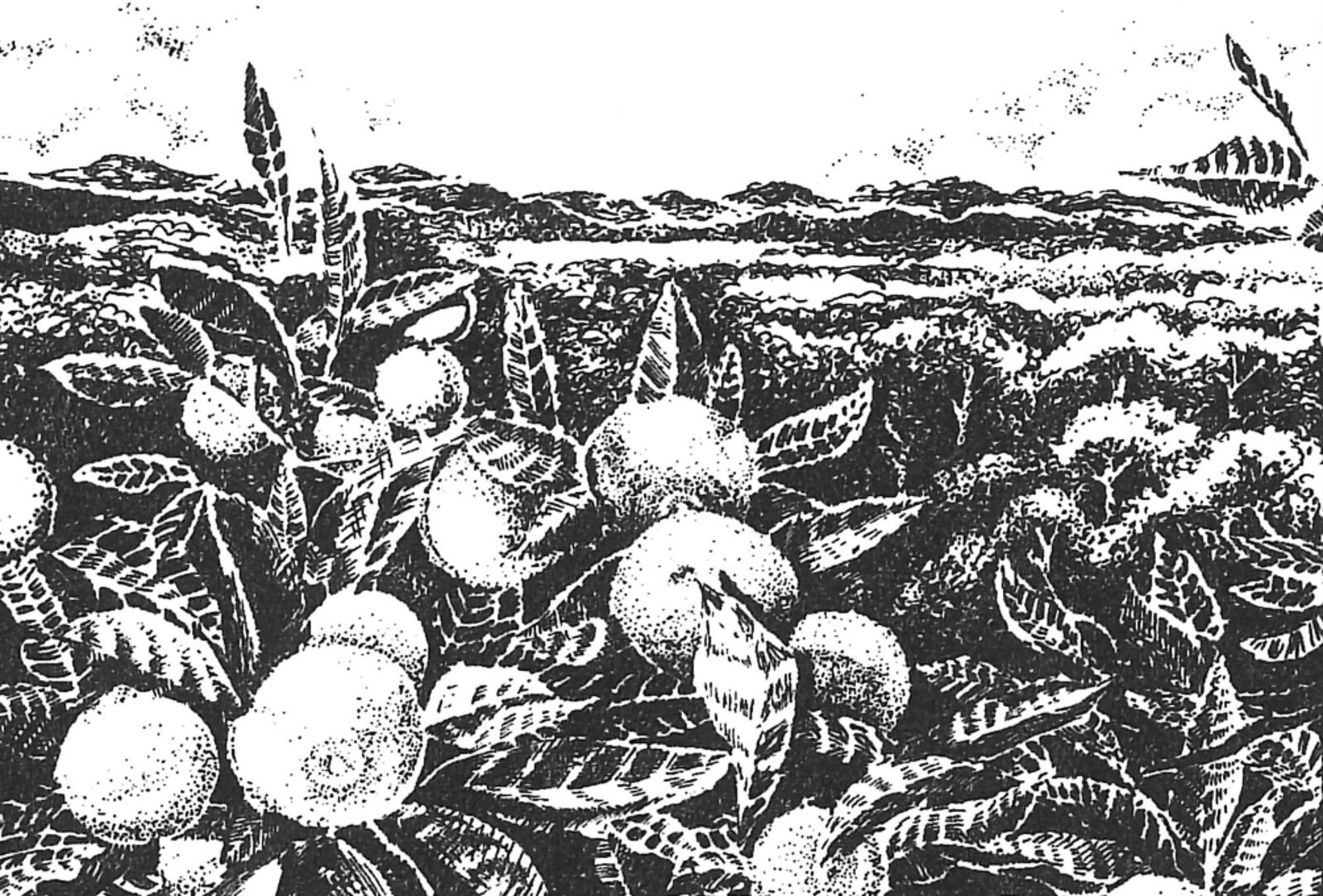
From: Masanobu Fukuoka, The One Straw Revolution, de Appel Library
I cannot help but think of our bordered reality. Borders, frontiers and lines. Physical, non-physical, visible, invisible, imposed, exclusionary. These imposed lines, so geometrical, are the core of neoliberalism. Math in its entirety. We measure the square metres of the land we own as a commodity, we count our money, plus and minus, we are reduced to numbers by governments on our identity cards, passports, residence permits: all products of this bordered world. If I squint hard enough, I begin to see the world through lines as well, through shapes. People become moving lines in front of static blocks of concrete. Is this how governments reduce us? To lines and finally numbers? I refuse to be a line that doesn’t bend, that doesn’t have a curve, that doesn’t form into a circle, a massive circle full of connected, bent, asymmetrical lines that form a world shared in common.
In September 2024, I started as an intern at de Appel, assisting Maria Nolla with the Curatorial Programme. This was the first time in its thirty-one years of existence that the Curatorial Programme took the form of a temporary masters, the Lumbung Practice: a collaboration between de Appel, Sandberg Institute and Gudskul in Jakarta. The masters materialised from the experience of documenta fifteen, anchoring its teachings in the Indonesian pre-colonial, rural practice of lumbung — the preservation of the excess harvest for the community’s future needs. As an art practice, lumbung reimagines art-making as a collective care and resource distribution, where process is valued over the final product and community over individual authorship. Through this experience, I found myself in a constellation of asymmetrical lines. People from different backgrounds, contexts, ethnicities, gathering together to learn how to navigate the dynamics of collectives and communities, resisting all at once the individualistic doctrine of neoliberalism.
A core part of lumbung teachings is lumbung land. Based on the seeds laid by documenta fifteen, the concept of lumbung land is defined as follows: “a space where a community has agency, can govern resources collectively and build a lumbung value based economy and independent artistic practice.”
From: Masanobu Fukuoka, The One Straw Revolution, de Appel Library
A space where a community has agency. It is within this understanding of the commons and of collectively owned land and urban spaces that the event Lumbung Land was organised at de Appel by the participants of the temporary masters Lumbung Practice. The event took place as part of the Lumbung Practice’s first-year final project: the damdam Harvest Festival.
By placing emphasis on the community, a shift takes place in the global market dynamics. Land is no longer a commodity but a shared commons. In this shift, the rigid, bordered land lines imposed from above lose their cold geometry and acquire a new essence. Land lines and people — as a unified entity/community — bend, intersect and dissolve into asymmetrical forms. Lines that bend together, carving paths in dialogue. Land lines and people are one, never separate.
If we then start to think of urban spaces as carved from within, we get a sense of what Karin Christof, guest speaker at Lumbung Land, talks about when she speaks of autonomous urban spaces. These are spaces where living, working and socialising escape the strict, neoliberal logic of profit and become contested commons. Christof bases her research on the specific context of the Netherlands. Examples of such spaces are cooperatives, cultural centres and squats. These spaces emerge as breathing holes within a concrete order, which constantly navigate and negotiate with public authorities, economic pressures and the shifting needs of communities. Their political value, intrinsic to the historical origin of the Dutch squatting movement, marks a resistance to the ongoing housing crisis that troubles Dutch citizens to this day. The squatters become what Christof calls citizen professionals: people who work both within and beyond institutional frameworks, building infrastructures of care, culture and resistance. The independence that comes with living in an autonomous urban space is never pure or absolute, according to Christof’s view. It exists in a state of post-autonomy, where there is constant negotiation. This negotiation is not a compromise but a skilful act of safeguarding what the speaker terms a mutually assured autonomy, where different spaces, networks and actors defend one another’s right to exist. The exegesis is that the value of autonomous urban spaces lies in their power to decolonise our imaginaries and actively construct communities based on solidarity, care and generosity.
A distinct example of a communally owned land in the Dutch context is Voedselpark Amsterdam, the city’s last remaining sea-clay farmland. Co-founder Natasha Hulst spoke at the Lumbung Land programme about the decommodification of land through the act of buying land and transforming its value through its use. Hulst’s theory is grounded in the tradition of Community Land Trusts (CLT), a model rooted in the U.S. Civil Rights movement of the 1960s, originally designed to secure access to farmland for Black farmers excluded through segregation. Natasha Hulst speaks of decommodification not as an abstract policy goal, but as a concrete act of counter-mapping; taking land out of the speculative cycle and re-situating it within the domain of the commons. This act becomes a collective apparatus that refuses the linear temporality of extraction. It is, in essence, what Silvia Federici defines as reproductive value, where the value is based on the longevity of life sustainment across communities, cultures and generations. Rigid geographies of cadastral maps transform into convivial topographies, full of asymmetrical lines that do not cut, but mould into thresholds of care, rather than fences of exclusion.
From: Masanobu Fukuoka, The One Straw Revolution, de Appel Library
When we then talk about autonomous urban spaces and communally-owned lands, we speak of the reversal of dominant land ideologies. Christof argues that such reversal enables those without ‘power’ to say “the city is also mine”. I wonder if through this decolonisation of our imaginaries, we will eventually move far beyond the language of possession.
These are thoughts that The Zapatismo Study Group expanded on, as the last speakers of Lumbung Land. Presenting a parallel epistemology of lumbung land, territory emerges not as a static object of governance but as a living interlocutor, according to the Zapatistas. Their practice of El Común is a refusal of the colonial fiction that the land belongs to people; instead, we belong to the land, bound by reciprocal obligations. Borders, in this cosmology, are porous lines, continually negotiated through assemblies that embody a politics of presence rather than representation. This praxis weaves indigenous territorial logics with anti-capitalist actions to redraw the lines on the map from below. The result is a geometry of reciprocity, where the line curves back into the commons and, instead of dividing, becomes an itinerary of solidarity — a path that returns us to one another and to the land as co-equal participants in the political community.
To counter the current status quo, I ask: how can we ignore practices like lumbung and its subcategories? It’s time that we reverse the shot — after Marwa Arsanios’s film Who is Afraid of Ideology? — give land a voice. To follow this path is to enter a politics of presence, where the commons is not a utopian ideology but an everyday practice. Against the straight lines of neoliberalism, these practices sketch another geometry: porous, curved, constantly negotiated. A geometry where ideology is not an abstraction but a way of inhabiting the world together, bending the line until it forms a commons we can all enter.