Mundo Papa by Santiago Pinyol
The following piece was written by Santiago Pinyol as part of Ulufer Çelik and Özgür Atlagan's project de aardAppel, one of this year’s de Appel Kiosk projects. de aardAppel was a hybrid stall at Dappermarkt, consisting of a micro-publishing house and a potato-salad-kiosk, where passersby could buy a potato salad, or get a portion in exchange for a ‘potato anecdote’. This text, published in a stencil-printed zine they made during their days on Dappermarkt, delves into the social and linguistic history of the potato.
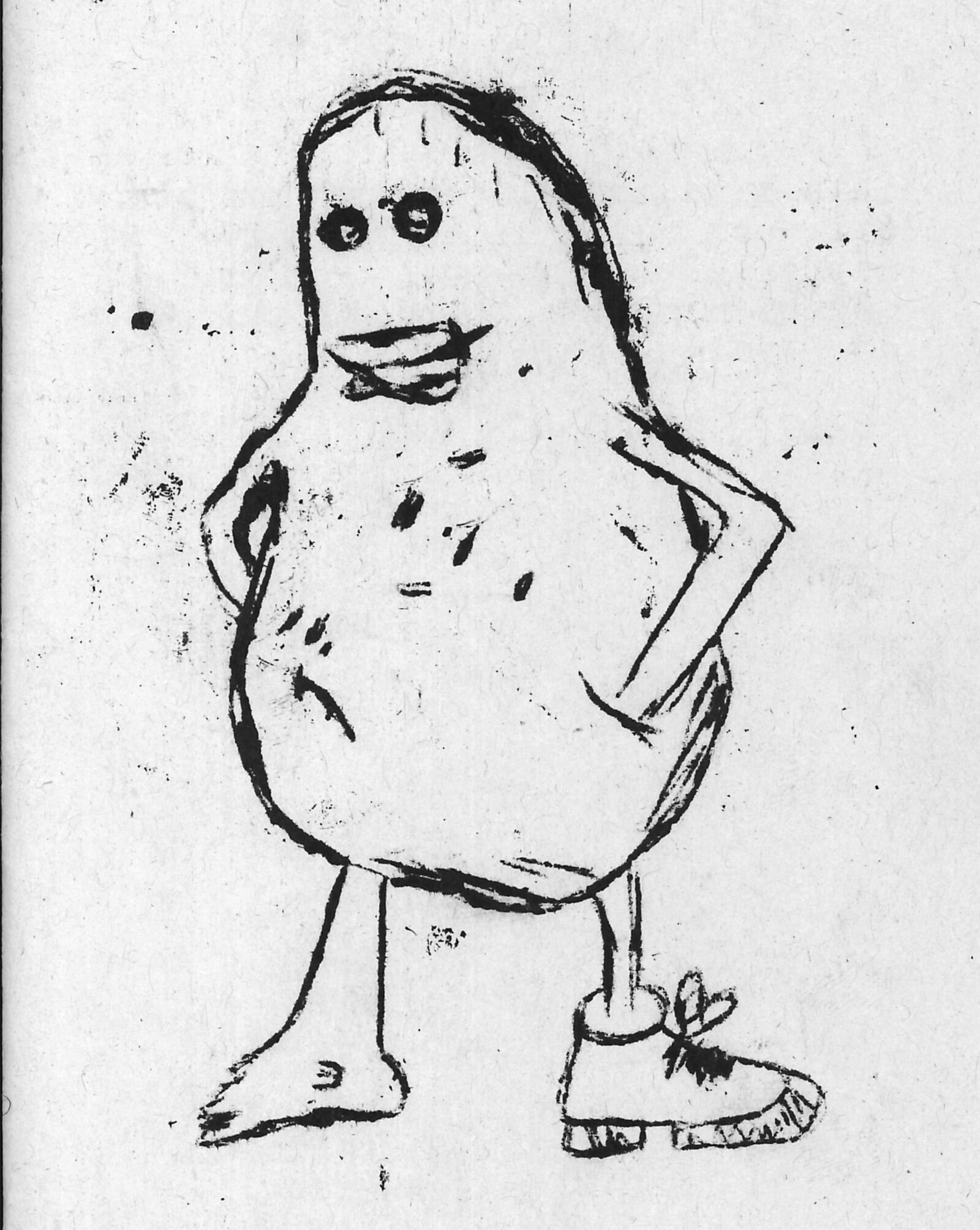
From: Is it a good year for potatoes?, de aardAppel Amsterdam (Ulufer Çelik and Özgür Atlagan)
Modern states fundamentally rely on the development of nationalist practices that create the illusion of a common past, a shared identity, and the need for a single language. And yet, the existence of linguistic diversity will continue to refuse, by negating in multiple languages, the paralyzing discourse of any form of nationalism.
– Yásnaya Elena A. Gil. Languages and Nation-States¹
Mundo Papa
When I started to think about what to write for this text, I looked for the etymology of “papa” (potato) and “tierra” (soil, earth) because of what “papas” are called in the Netherlands: “aardappel” (earth apple). Between those three names that name the same plant and tubercule — papa, potato and aardappel — there is a whole story.
I sometimes have that impulse to dig into the understanding of a word by looking at its history, at its roots, a form of study or field of knowledge known as etymology. Here is the etymology of the word etymology according to Wikipedia: “(...) is derived from the Ancient Greek word ἐτυμολογία (etumologíā), itself from ἔτυμον (étumon), meaning ‘true sense or sense of a truth’, and the suffix -logia, denoting ‘the study or logic of’.” Literally, “the study of the true sense of words”.
From a decolonial perspective, etymology presents several problems tied to colonial histories and power hierarchies: prioritising Greek, Latin and/or Old English as the primary sources of meaning and truth reinforces the idea of Europe as the cradle of civilisation. A move that marginalises non-European indigenous linguistic traditions. Furthermore, this search for an ‘origin’ can also relate to and reflect a Western, linear understanding of history that doesn’t always align with oral traditions or non-Western ways of feel-thinking.
The suppression or extinction of local languages is/was often an integral part of colonial onto-epistemological violence through imposing new names on places, people and concepts. That is why the etymologies of many words in certain non-hegemonic languages are incomplete or lost forever. Hegemonic languages are backed up by a vast body of resources such as dictionaries, dedicated institutions and policies that enforce their use.
Here in Europe, this prioritisation of one language over others happened alongside the establishment of the modern nation-state, as Yásnaya Elena A. Gil reminds us. An example of this was the development of state-backed education systems that broke the “Dialect continuum” between many peoples and “lenguas”. “Dialect continuum” describes how a range of languages and dialects were spoken across large geographical areas, differing only slightly between areas that are geographically close to each other, and gradually decreasing in mutual intelligibility as the distances become greater. An example of this is how, between the Netherlands and Germany, one language fades into the other rather than stop at an imaginary line in the middle of nowhere:
“On both sides of this border, the people living in the immediate surroundings spoke an identical language. They could understand each other without difficulty, and they would even have had trouble telling from language alone whether a person from the region was from the Netherlands or from Germany. However, the Germans here called their language German, and the Dutch called their language Dutch (...).”²
Papa caliente
As the Spanish conquistadors stumbled upon Abya Yala they encountered fauna, flora and culture unknown to them.³ Things for which they lacked words, of course, like with the two tubers this small text is about: papa (potato) and batata (sweet potato). The word "papa" is of Quechua⁴ origin⁵ and the word “batata” is of Taíno⁶ origin, both pre-Columbian words pre-dating the colonisation of Abya Yala. They are examples of the many words in contemporary Spanish and English that come from indigenous languages, like avocado, chocolate, tomato, barbecue and many more delicious things.
The story goes that there was some confusion regarding the potato’s nomenclature, as the sweet potato, and with it the word “batata”, was introduced to Europe many centuries before the potato or “papa”. At some point, in some places, both began to be called "patata" and, eventually, "patata" became the common name for potato in Spain. Today, the word “papa” is used throughout Abya Yala and in certain regions of Spain, such as Andalucía, and in some parts of Murcia and Extremadura. There is still a funny controversy between people from Abya Yala and Spaniards over what to call this tuber. You might think that it’s a “you say patata, I say papa” sort of situation, but the way I see it, you are either saying it in Quechua or saying it in Taíno.
But here in the Netherlands, the name “aardappel” (earth apple) reflects a different history and a common strategy in Europe when naming the unknown, especially new foods or non-human animals: comparing them to already known elements and composing a new word. In this case, the round shape and somewhat sweet taste of the (boiled) potato are associated with an apple, and its underground origin was added to the name in a poetic twist. In Old German and Old English, similar forms were also used before “kartoffel” and “potato” became common in each of those languages.
From: Is it a good year for potatoes?, de aardAppel Amsterdam (Ulufer Çelik and Özgür Atlagan)
Agri-Cultural⁷ Monoculturisation
“Dominant scientific knowledge thus breeds a monoculture of the mind by making space for local alternatives disappear, very much like monocultures of introduced plant varieties leading to the displacement and destruction of local diversity. Dominant knowledge also destroys the very conditions for alternatives to exist, very much like the introduction of monocultures destroying the very conditions for diverse species to exist.”
– Vandana Shiva, Monocultures of the Mind
Ten thousand years ago, “papas” were domesticated by Indigenous peoples in a plateau in southern Perú. Today, there are more than four thousand varieties of “papas” in Perú. Here is a list of some of the most commonly used ones:
Papa amarilla, Papa blanca, Papa negra, Papa wenco, Papa huamantanga, Papa peruanita, Papa huayro, Papa tumbay, Papa yungay, Papa perricholi. Each of these names describe how “papas” are recognised by their very different external appearances (shape, size, skin colour, eye/navel distribution), their internal characteristics (colour, texture, flavour), and their uses, which can be distinct in Peruvian cultures. In some cases, other considerations are also taken into account (seasonality, growing region, etc.).⁸
The “papa” we consume and name today is the result of a process of Agri-Cultural Mono-Culturisation. At the same time in the farming process of growing one crop species in a field at a time and in the monoculturalist process of globalisation.
The “papa” as a symbol of agricultural monoculture tells the story of industrial agriculture, especially in the Global North, where “papas” are grown in large monocultures. These are single-crop systems that dominate the landscape, exhaust soil nutrients, and require heavy inputs of pesticides, fertilisers and irrigation. This type of farming also relies on clonal reproduction (asexual propagation of tubers), which limits genetic diversity. This makes crops highly vulnerable to disease, as seen in the Great Irish Potato Famine,⁹ or more precisely, the “An Gorta Mór”¹⁰ or “Great Hunger”, when, during British Colonial rule, a single strain of potato dominated the landscape and failed catastrophically.
The potato, especially as French fries or potato chips, is one of the most ubiquitous food products in global fast-food chains. This reflects a cultural homogenisation of diet, taste and temporality (easy and fast eating). Potatoes are a calorie-dense, starch-heavy crop. When elevated to staple status within poor, urban, or post-colonial diets, it often replaces more diverse, nutrient-rich traditional foods, reinforcing forms of dietary monoculture linked to poverty and dependency.
The dangers of monoculture for all are obvious when we talk about agriculture and soil, health and gut bacteria, and in culture and language. They make systems weaker, less tasty, and frankly boring. Going back to language, when one goes extinct, ceasing to be actively spoken, which happens approximately every two weeks, what do we lose? When we lose a language, we lose a whole world — radically different ways of being in the world.
Caldo e’ papa
“The potato is an intermittent resource available only during the harvest season in Colombia. The potato is a food that erodes over time… that’s where edible landscapes deliver a powerful message that leaves a question hanging in the air: What will we live on in the future if everything erodes?”
– Ernesto Restrepo Morillo, ‘El Papas’¹¹
This text is not an effort to restore things to their original meaning, or to claim ownership. With all the historical translations, “papas” remind me of the stubbornness and beauty of language. To know that each day we might be pronouncing and touching upon so many different tongues. And maybe all this meandering, tongue-twisting, decolonial ranting will make you taste and appreciate them differently, feeling their journey and everything that goes into them and their story. Hopefully un-doing some of the mono-culturalism that we are forced to taste everyday.
Here is a simple broth cooked in Colombia for when you have a funny tummy. It is a light and humble dish that also highlights the medicinal properties of “papas”:
○ Finely chop 1 green onion and lightly fry it.
○ Irregularly cut 8 medium/large size “papas” into small shapes.
○ Add 5 cups of water and bring to the boil, add butter (optional) and salt to taste.
○ When the water boils, add the irregularly cut “papas”. You can use one or many types of “papas”. I challenge you to use at least three types.
○ Let it boil gently for about 15 minutes.
○ Finely chop some cilantro.
○ Check that the “papas” are soft, serve hot and add cilantro.
1 Yásnaya Elena A. Gil (Aguilar Gil), “Languages and Nation‑States,” in Thread of Translations, no. 53 (May–June 2024), trans. Ivonne Santoyo‑Orozco, The Funambulist Magazine, accessed July 23, 2025.
2 https://www.citizendium.org/wiki/Dialect_continuum. Accessed July 23, 2025.
3 Abya Yala is used today by Indigenous ethnic communities in North and South America to refer to the landmasses generally known as the Americas/America. Abya Yala is a term derived from the Guna language of the Kuna people indigenous to Panama and Colombia translating to “land of fertile blood.”. Harvard Library. “Abya Yala.” Harvard University, https://library.cfa.harvard.edu/abya-yala#:~:text=Abya%20Yala%20is%20used%20today,%E2%80%9Cland%20of%20fertile%20blood.%E2%80%9D. Accessed July 23, 2025.
4 “Quechua (...) is an indigenous language family that originated in central Peru and thereafter spread to other countries of the Andes.” Wikipedia, last modified July 19, 2025 https://en.wikipedia.org/wiki/Quechuan_languages
5 The actual etymology of the word “papa” is quite complex, this is a very simplified version.
6 “Taíno is an Arawakan language formerly spoken widely by the Taíno people of the Caribbean.” "Taíno Language," Wikipedia, last modified July 22, 2025, https://en.wikipedia.org/wiki/Taíno_language
7 Here I use the term Agri-Culture to highlight that agriculture is more than just farming practices passed down. Agri-Cultures embody the profound link between how land is cultivated and who we are as communities and individuals. It is a metabolic literacy poetic license.
8 International Potato Center. The Potato: Cultivating Diversity and Improving Livelihoods. Lima, Peru: International Potato Center, 2008. https://cipotato.org/wp-content/uploads/PDF/003524.pdf.
9 “In England’s first colony, Ireland, a lack of genetic diversity had left the potato crop vulnerable to infection by a fungus. From 1845 to 1849, a million Irish citizens died from famine. And yet in 1846 Ireland exported 500,000 pigs and 30,000 tons of grain to England, where prices were higher. The Irish died for want not of food but of money to buy it.” Rupa Marya and Raj Patel, Inflamed: Deep Medicine and the Anatomy of Injustice (New York: Random House, 2023), 37.
10 Some even consider that the famine amounts to a crime against humanity and as a genocide against the Irish. “While the famine may not have been planned per se, Britain clearly demonstrated both genocidal policy and rhetoric both during the famine and throughout Irish history in general.” Nathaniel Hill. An Gorta Mór: The Question of the Irish “Genocide”. Genocide Watch Blog, 2021. Accessed July 23, 2025.
11 Ernesto Restrepo Morillo, aka ‘El Papas’, is a Colombian artist that for more than thirty years has dedicated his entire practice to work with potatoes. Please check out his work: https://www.instagram.com/elpapasproductions/